

How To Create Adobe Analytics Account

R Client for Adobe Analytics API 2.0
Connect to the Adobe Analytics API v2.0, which powers Analysis Workspace. The package was developed with the analyst in mind and will continue to be developed with the guiding principles of iterative, repeatable, timely analysis. New features are actively being developed and we value your feedback and contribution to the process. Please submit bugs, questions, and enhancement requests as issues in this Github repository.
A Note about 2.0 vs. 1.4
The Adobe Analytics v1.4 API, while on its way out, still has some functionality that is not (yet?) available in the v2.0 API. As such, the RSiteCatalyst package created by Randy Zwitch remains a useful package. While this is not a comprehensive list, some of the features that are available through RSiteCatalyst that are not available through the v2.0 API (and, by extension, are not available through this package) are:
- Data Warehouse queries
- Marketing Channel configuration and processing rules
- Data Feed details
The v1.4 API also allows the user to pull data once they have web services access set up for their account and the client ID and client secret that comes along with that. In other words, it does not require that an Adobe Console API project be created, which is something that is required to use the v2.0 API. The benefit of getting an Adobe Console API project set up, though, is that the user then does not need web services access set up on an account-by-account basis to pull data using the package.
As a purely editorial side note, the creators and maintainers of this package would like to express their eternal gratitude to Randy for the work he put in to creating and maintaining RSiteCatalyst. His work brought the power of R combined with data pulled directly via the Adobe Analytics API to a global audience, and we can only hope (for ourselves and the analyst community writ large) that adobeanalyticsr can live up to the high standard he set with his work.
Current setup process overview
There are four setup steps required to start accessing your Adobe Analytics data. The following steps are each outlined in greater detail in the following sections:
- Create an Adobe Console API Project
- Create and add the OAuth arguments to your
.Renvironfile. - Get your authorization token by using the function
aw_token(). - Get your
company_idby using the functionget_me().
1. Create an Adobe Console API Project
Regardless of how many different Adobe Analytics accounts you will be accessing, you only need a single Adobe Console API project (you will still need to have working user credentials for each account you want to access, but the Adobe Console API project is just the way you then get access to authenticate using those user credentials; yes…confusing!):
- Navigate to the following URL: https://console.adobe.io/integrations.
- Click the Create New Project button.
- Click the Add API button.
- Select the Experience Cloud product icon and then choose Adobe Analytics and click Next.
- Select the OAuth option and then click Next.
- Select Web as the platform where you want the integration.
- Add Default redirect URI
https://adobeanalyticsr.com/token_result.html* - Add Redirect URI pattern
https://adobeanalyticsr\.com/token_result\.html*
* This is simply a helper site I've set up in order to make it easier to generate a token. The site does not store any information.
If you are knowledgeable of the ins and outs of this auth process and feel you have a better way to explain and/or set this up, please submit an issue or create a pull request with your recommendation!
Creating an Adobe Console API Project in under 60 seconds 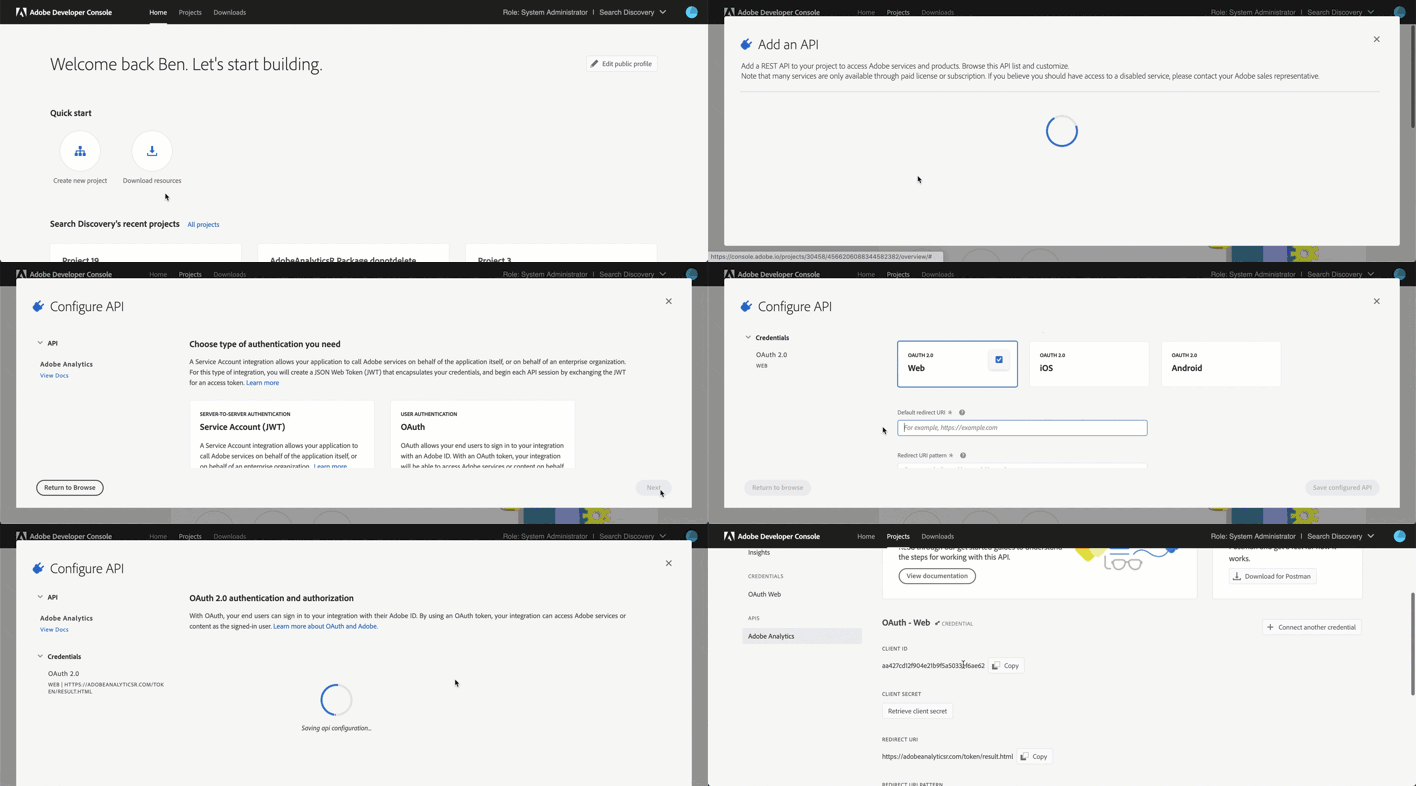
2. Set up the .Renviron file
This file is essential to keeping your information secure. It also speeds up analysis by limiting the number of arguments you need to add to every function call.
-
If you do not have an
.Renvironfile (if you have never heard of this file you almost certainly don't have one!), then create a new file and save it with the name.Renviron. You can do this from within the RStudio environment and save the file either in yourHomedirectory (which is recommended; click on the Home button in the file navigator in RStudio and save it to that location) or within your project's working directory. -
Get the following variables from the OAuth project and add them to the file* (see Creating an Adobe Console API Project above):
-
AW_CLIENT_ID- OAuth client id found in the Adobe Developer Console -
AW_CLIENT_SECRET- OAuth client secret key found in the Adobe Developer Console
-
-
(Optional) Add
AW_COMPANY_IDandAW_REPORTSUITE_IDvariables once you know them (how to find available values for these two variables is described in step 4 below).
After adding these 2-4 variables to the .Renviron file and saving it, restart your R session (Session > Restart R in RStudio) and reload adobeanalyticsr (library(adobeanalyticsr)).
* The format of variables in the .Renviron file is straightforward. If you add all four of the variables above, they would simply each be their own line in the file:
AW_CLIENT_ID = "[OAuth client ID]" AW_CLIENT_SECRET = "[OAuth client secret]" AW_COMPANY_ID = "[Company ID]" AW_REPORTSUITE_ID = "[RSID]" 4. Confirm the process worked and get available company_id and reports
The last step is to get your company_id (or, if you have access to multiple accounts, get the company_id you want to work with). This is also an excellent way to confirm that everything is set up correctly:
- In the console, type
get_me()and press. - You should then see a list of all of the companies you have access to. The globalCompanyId value is what you will use to specify the company that you want to access. If you are working solely (or primarily) with one company, then consider adding the
company_idasAW_COMPANY_IDin your.Renvironfile as described in step 2 above. Otherwise, you can specify it within each function call that requires it. - If you will be working solely (or primarily) with a single report suite, then consider adding the report suite ID (RSID) as
AW_REPORTSUITE_IDin your file as described in step 2 above. You can retrieve all of the report suite IDs for a givencompany_idusing the functionaw_get_reportsuites(company_id = '[the company ID for account of interest]').
If you added any values to your .Renviron file (and then saved it!), then restart your R session (Session > Restart R in RStudio) and reload adobeanalyticsr (library(adobeanalyticsr)).
How To Create Adobe Analytics Account
Source: https://adobeanalyticsr.com/
Posted by: andersonarou1937.blogspot.com
0 Response to "How To Create Adobe Analytics Account"
Post a Comment